
The First-Frame Problem
Reputation for a state-proximate entity is not won by controlling a message. It is won or lost by which story reaches the primary audience first, because that first frame resists correction even after the facts change.

What Al Qudsia’s Rise Reveals About Reputation Infrastructure in State-Proximate Sport
Reputation for a state-proximate entity is not won by controlling a message. It is won or lost by which story reaches the primary audience first, because that first frame resists correction even after the facts change.
Strategic Essay | Prince Researcher
Abstract
Reputation outcomes for state-proximate institutions are often decided before anyone writes a press release. They are decided by which story reaches the audience first. This essay calls that mechanism First-Frame Lock.
Global reputation management assumes a single audience and a single controllable narrative. State-proximate entities in the Gulf face three audiences at once. Those audiences do not share assumptions, and the standard playbook was not built for that condition.
Building on framing theory and reputational capital theory, this essay proposes First-Frame Lock as a new mechanism. Whichever narrative reaches the primary audience first becomes the lens through which every later fact is read. Good results do not erase a bad first frame. They get filtered through it instead.
The essay tests this mechanism against two cases. Al Qadsiah, the Saudi football club owned by Aramco, is one. Newcastle United, owned by Saudi Arabia's Public Investment Fund, is the other. In one case the merit story arrived first. In the other, the capital story did. The central argument: reputation is not a campaign layered onto results. It is infrastructure, and infrastructure has to be built before the audience arrives.
Introduction
Reputation for a state-proximate institution is rarely won by the quality of its messaging. It is won by sequencing, by which story reaches the audience first and sets the terms for everything that follows. Al Qadsiah's 2025–26 season is a clean test of that claim. The club finished fourth in the Saudi Pro League, ahead of Al-Ittihad, the reigning champion it had once played two divisions below. Its owner is Saudi Aramco, the largest company in the Kingdom, and international coverage of the season barely mentioned that fact.
That gap between ownership and coverage points to a structural problem the standard reputation playbook does not resolve. Western reputation strategy assumes a single audience and a controllable message. Al Qadsiah answers to three audiences that do not share the same starting assumptions. International sports media reads Saudi football through the lens of state investment. A domestic fan base wants a competitive, authentically Saudi club. A commercial market is testing whether privatized Saudi clubs can justify themselves on revenue rather than spend.
This matters beyond one club. Saudi Arabia's 2023 privatization program moved eight clubs out of Ministry of Sport ownership into the hands of state-linked companies and development bodies. Every one of those clubs now carries the same three-audience problem. None of them can solve it with better press releases.
This essay builds a framework for that problem. It draws on three academic lenses: impression management, reputational capital theory, and framing theory. It tests the framework against two cases, one where the club's own story arrived first and one where it did not. The mechanism this produces is not specific to football. It applies to any institution operating inside a proximity chain to state power, including sovereign wealth funds, state-owned enterprises, and universities carrying a national mandate.
Theoretical Framework
Dramaturgy and the front stage
Erving Goffman described social life as a performance, front stage presentation while controlling what happens backstage. Applied to institutions, the front stage is what the public audience sees: match results, signings, stadium atmosphere. The backstage is ownership structure, governance decisions, and the sensitivity layer that decides what gets said and when.
The failure mode for state-proximate entities is a collapsed stage. When the backstage becomes visible before the front stage has established its own story, the audience reads the institution through the backstage instead. This is the condition First-Frame Lock describes, and the Newcastle United case below shows it in full.
Reputational capital
Charles Fombrun defined reputation as an accumulated asset, built over time through consistent signals rather than a single campaign outcome. Reputational capital compounds. It also erodes slowly, so a bad early signal does not get washed out by later good ones. It sits underneath them.
This matters for privatized Saudi clubs because they start from zero. A club transferred from Ministry of Sport ownership carries no accumulated reputational capital as a private commercial entity. Every early signal counts disproportionately, because there is no backlog of trust to absorb a bad one. First-Frame Lock is what happens when that first signal hardens before any other evidence arrives to compete with it.
Framing theory
Robert Entman’s framing theory holds that whoever defines a situation’s central problem controls how audiences interpret every subsequent fact. Framing is agenda-setting before the fact, not persuasion after it. Once a frame takes hold, later information gets sorted into it rather than evaluated on its own terms.
This is the direct mechanism behind First-Frame Lock. The frame that reaches an audience first is not just an early advantage. It becomes the interpretive structure for everything that follows, including evidence that would otherwise contradict it. The two cases below test whether this holds outside of theory.
Case Studies
Al Qadsiah: the merit story arrived first
Initial conditions. Al Qadsiah spent the 2010s in decline. The club dropped out of the Pro League entirely after the 2020–21 season and carried no significant international profile. Its domestic weight was limited to the Eastern Province.
Ownership transition. In 2023, Saudi Arabia’s sports privatization program transferred ownership of the club to Aramco, which is headquartered in the same region. The new administration prioritized football operations and academy development over the internal conflicts that had weakened prior leadership. The club won promotion to the Pro League in May 2024. Home attendance rose from modest First Division levels to close to 10,000 per game in its debut top-flight season.
Media framing. In December 2025, with the team fifth in the table, the club appointed former Celtic and Liverpool manager Brendan Rodgers. Coverage of the appointment in The Express Tribune led with his departure from Celtic and his managerial record, mentioning Aramco’s ownership once, in a single descriptive clause. Rodgers oversaw a 13-match unbeaten run that included a 3-1 win over league leaders Al-Nassr in May 2026, ending a 20-game winning streak. Goal.com’s coverage of that title challenge led with the points gap to Al-Nassr and Rodgers’ managerial turnaround, with no reference to ownership structure at all. The club finished the season fourth, above reigning champion Al-Ittihad, with Julián Quiñones taking the league’s Golden Boot.
Strategic implication. The pattern across three independent sources is consistent: sporting performance, not ownership, became the dominant interpretive frame. Because Al Qadsiah’s ownership transition happened inside a domestic, technical process with limited early international scrutiny, the club’s results reached global sports audiences before its ownership structure did. First-Frame Lock set around the football story. Aramco’s involvement now reads as background detail in that story rather than the subject of one.
Newcastle United: the capital story arrived first
Initial conditions. Newcastle United entered 2020 under Mike Ashley’s ownership, criticized by its own fan base for minimal investment and a strained relationship with supporters. The club had no recent European pedigree and modest commercial standing.
Ownership transition. In October 2021, a consortium led by Saudi Arabia’s Public Investment Fund acquired an 80 percent stake in a £305 million takeover, following an 18-month regulatory approval process that became a public controversy in its own right.
Media framing. Independent outlets were already using the term sportswashing to describe the deal in 2020, more than a year before the takeover closed. A 2026 study in the Nordic Journal of Media Studies found that this framing dominated both legacy and social media discourse from the outset and persisted through the club's subsequent competitive improvement (Farrell-Banks & Merrill, 2026). A 2022 kit controversy, in which Amnesty International criticized new away colours resembling the Saudi national kit, shows how the ownership frame conditions the interpretation of a routine commercial decision a full year after the deal closed.
Strategic implication. Newcastle’s ownership story reached its primary audience, international and domestic English football media, before any football story existed to compete with it. First-Frame Lock set around sportswashing rather than sport. Peer-reviewed research on fan response describes supporters managing this through identity-maintenance strategies rather than through reputational resolution, which suggests the frame has not shifted even among the club’s own base (Jones, Adams & Mayoh, 2024).
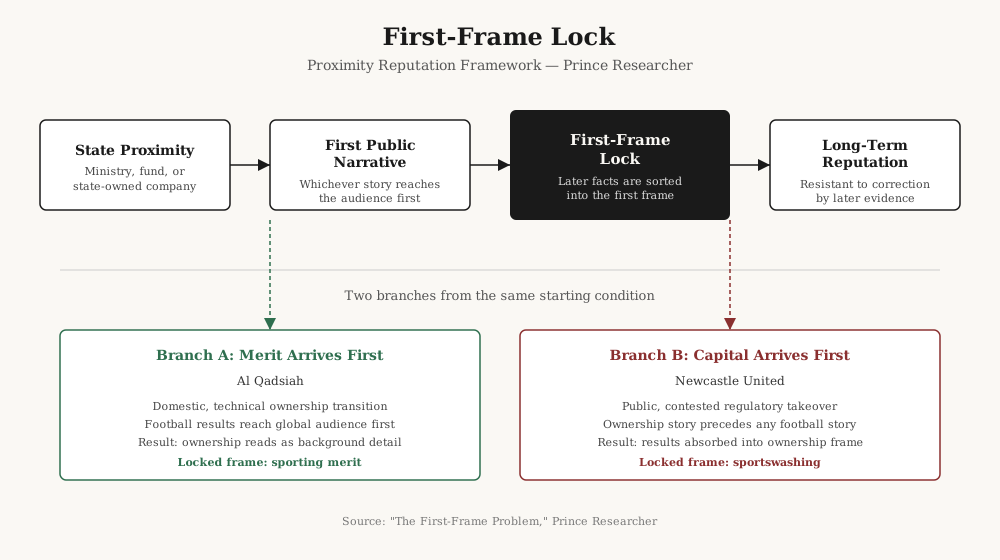
Synthesis Framework
Taken together, these contrasting cases suggest a broader mechanism that extends beyond football to any institution operating inside a proximity chain to state power. Both clubs share an ownership structure: state-proximate capital entering a football institution. They produced different reputational outcomes because of sequencing, not intent. This essay proposes the Proximity Reputation Framework, built on four components.
Proximity Classification. Every state-proximate entity sits at a measurable distance from the state itself: direct ministerial ownership, control by a sovereign wealth fund, or corporate ownership by a majority-state-owned company. That distance determines how much scrutiny is automatically attached to any public action, regardless of what the entity actually does.
First-Frame Sequencing. The entity must identify which story, capital or merit, is more likely to reach its primary audience first, and build for that sequence deliberately. Where the capital story cannot be delayed, as in a Premier League takeover requiring public regulatory approval, the entity should plan for a longer-horizon reframing strategy rather than assume avoidance is possible.
Audience Triangulation. Reputation strategy has to hold three narratives at once without contradiction: a merit narrative for international press, an authenticity narrative for domestic audiences, and a viability narrative for commercial partners. A message calibrated for one audience can undermine credibility with another if the entity is not explicit about which audience each communication serves.
Sensitivity Layering. Every public action must be classified by its proximity to the state chain and calibrated in tone, timing, and channel accordingly. A transfer announcement from a ministry-owned club carries different weight than the same announcement from a fully private club, even when the football content is identical.
First-Frame Lock is the mechanism that connects these four components. It explains why Al Qadsiah’s Aramco ownership reads as background and Newcastle’s PIF ownership reads as foreground, despite both being state-proximate acquisitions inside the same five-year window. A visual summary of the mechanism follows this essay as a companion diagram.
Conclusion
Al Qadsiah’s fourth-place finish is not proof that Saudi sports reputation management has been solved. It is evidence that sequencing worked once, under conditions unlikely to repeat for every future privatized entity.
The standard reputation playbook assumes one audience. State-proximate entities rarely have one. First-Frame Lock means the entity that wins is not the one with the best message. It is the one whose true story reaches the audience before a simpler, more available story fills the space.
This applies well beyond football. Sovereign wealth funds, state-owned enterprises, universities carrying a national mandate, and technology firms operating close to government all face the same sequencing problem. Reputation strategy for these entities has to begin in the design of the process itself, long before an outside audience exists to read it.
Reputation, for entities inside a proximity chain to state power, is not something announced after the fact. It is a structure built in advance so that, by the time anyone asks the hard question, the frame to answer it is already in place.
References and Further Reading
- Entman, R. M. (1993). Framing: Toward Clarification of a Fractured Paradigm. Journal of Communication, 43(4).
- Farrell-Banks, D., & Merrill, S. (2026). The Nostalgic (De)legitimation of Sportswashing: Social Media and Legacy Media Reactions to the Saudi Arabian State Takeover of Newcastle United. Nordic Journal of Media Studies, 8(1), 81–98.
- Fombrun, C. J. (1996). Reputation: Realizing Value from the Corporate Image. Harvard Business School Press.
- Goffman, E. (1959). The Presentation of Self in Everyday Life. Doubleday.
- Jones, I., Adams, A., & Mayoh, J. (2024). Fan Responses to Ownership Change in the English Premier League: Motivated Ignorance, Social Creativity and Social Competition at Newcastle United F.C. International Review for the Sociology of Sport.
- Saudi Pro League. Official match reports and club statistics, 2024–2026 seasons.
- Saudipedia. Saudi Sports Clubs Investment and Privatization.
- The Express Tribune. Brendan Rodgers Joins Saudi Club Al Qadsiah (December 2025).
- Goal.com. Coverage of Al Qadsiah's 2025–26 title challenge and Rodgers' managerial record.
© Strategic Essay — Prince Researcher | For Academic and Editorial Use