Custodians, Not Authors: How Nations Build Soft Power Through the Stories of Their People
National reputation grows strongest when the state stops authoring the story and starts stewarding the people who carry it.

National reputation grows strongest when the state moves from authoring the national story to stewarding the people who carry it.
Cultural Essay | Prince Researcher
Abstract
Nations spend heavily to shape how the world sees them. Most of that spending flows toward projecting the state and its leadership. This essay argues that the emphasis is misplaced. Soft power is the capacity to attract, and attraction resists command. A nation's most credible signal tends to come from the people who carry its culture, not from the institutions that govern it. When a state praises itself, global audiences read the motive and discount the message. When citizens, artists, and heritage carry the story, the signal becomes more credible, more durable, and harder to fake. This essay introduces the Custodian Model of nation branding. In this model the people author the national narrative and the state stewards the conditions that let them. Three mechanisms explain its strength. Credibility Transfer raises trust by shifting the signal to disinterested sources. Distributed Durability protects reputation by removing single points of failure. Narrative Depth converts attention into lasting affinity. South Korea illustrates the model at work. Japan illustrates the limits of a state authoring culture instead. Saudi Arabia holds an unusually deep citizen-borne asset. The essay argues that the most durable national reputations are earned by citizens and merely kept by states.
Introduction
Governments now treat national reputation as a budget line. They commission campaigns, hire agencies, and buy visibility at summits and stadiums. Much of that effort points inward toward the state, projecting a capable government and a benevolent leadership.
The instinct sits uneasily with the mechanics of the thing it wants to build. Joseph Nye, who named soft power, placed its sources largely outside the state. He located them in culture, values, and civil society. A country tends to attract others through what its people make and how they live, more than through what its officials announce about themselves.
This creates a gap between practice and evidence. States often spend the most on the instrument that appears to work the least. Simon Anholt, who created the field of nation branding, later warned that reputation cannot be constructed through messaging. He called the belief that marketing can shift a national image an extravagant delusion.
The stakes are large for any nation entering the global conversation on its own terms. Saudi Arabia is investing a decade and significant capital to be understood differently. So are many countries with deep culture and thin recognition. The question is not whether to invest. The question is where the investment belongs.
This essay makes a direct proposal. It argues that the people are the most powerful carriers of a nation's story, and that the state's highest-leverage role is custodial rather than authorial. It builds a framework called the Custodian Model, explains why audiences tend to trust citizens over governments, tests the model against South Korea and Japan, applies it to Saudi Arabia, and sets out conditions that other nations could examine.
Theoretical Framework
Four lenses help explain why a population may carry national reputation more effectively than a state does.
Soft power and the limits of the state
Nye separated hard power from soft power. Hard power coerces through force and money. Soft power attracts through culture, values, and conduct. His central point is often missed. A government controls only a small share of its own soft power. He compared a nation's image to a river with many sources, few of them under official command.
Nye drew a sharp conclusion. In the information age, he argued, the best propaganda is not propaganda, and credibility is the scarcest resource. A state that broadcasts its own virtue may spend down the very resource its appeal depends on.
Signalling and the psychology of the interested sender
Michael Spence built signalling theory around a simple asymmetry. A signal carries information only when it is hard to fake and costly to send. Audiences read the incentive behind a signal before they read its content.
This is where the Custodian Model finds its foundation. A government praising its own governance is a low-cost signal from an interested sender. A citizen who makes a film the world chooses to watch is a high-cost signal from a disinterested one. The difference lies less in honesty than in incentive.
Audience psychology helps explain why the difference matters. Attribution research, following Harold Kelley, indicates that people discount a message when an external motive can explain it. A government has an obvious motive to praise itself, so audiences tend to attribute the praise to interest rather than to truth. The persuasion knowledge model of Friestad and Wright adds a second layer. Audiences learn to recognize persuasion attempts and to defend against them. Overt state branding can trip that defence, while a meal, a song, or a film rarely presents as persuasion and so tends to pass through it. Reactance theory supplies a third layer. Heavy official messaging can provoke resistance, since an appeal pushed too hard may produce the opposite effect.
Authenticity closes the loop. When foreigners voluntarily consume, share, and cherish a culture, their behaviour functions as revealed preference rather than stated preference. It is costly, credible, and free of any agenda the audience can name. Citizens and artists appear to persuade not because they are more truthful than governments, but because they are less interested and less visibly trying to persuade. The Custodian Model works by placing the story with the people an audience has little reason to distrust.
Competitive identity and earned reputation
Anholt advised governments for years before turning against the term he coined. He concluded that advertising cannot readily move a national image, and that governments cannot fully control the national narrative. What they can do is act well and let their achievements speak. He revived Socrates on the point. The surest way to a better reputation is to become what one wishes to appear.
His research adds a finding relevant here. Nations with strong reputations tend to receive more generous interpretation of their later actions. Reputation behaves less like a mirror and more like a lens. Building that lens takes generations and resists acceleration by campaign.
Cultural capital and the value of depth
Pierre Bourdieu described culture as a form of capital that confers status and belonging. Cultural capital accumulates slowly and transfers across generations. It cannot be purchased outright, and it resists imitation because it is embedded in practice, taste, and memory.
A nation's heritage is cultural capital at civilizational scale. Cuisine, craft, music, language, dress, and sacred practice hold value that no state invented, and no rival can easily copy. This is the raw material of durable appeal. The state does not own this capital. Its people and communities do.
Read together, these lenses converge on a claim. A credible, durable, and distinctive national reputation tends to reside in a nation’s people and culture. The state can nourish it or spend it down, yet is poorly placed to manufacture it. The three cases that follow test whether this holds in practice, across a country that stewarded its culture, one that tried to author it, and one whose deepest asset predates any strategy.
Case Studies
South Korea: the custodian that let its people carry the story
What existed before. In the late 1990s, South Korea held a thin global image. The 1997 Asian financial crisis left the economy shaken and the national brand undefined beyond industry and conflict.
What was decided. In 1998, the Kim Dae-jung government launched a plan to support the cultural industry, treating content as an export sector. Cultural budgets rose from around 14 million dollars in 1998 to roughly 84 million by 2001, and continued to expand over the following decade. Agencies such as the Korea Creative Content Agency financed production, promoted exports, and opened channels abroad. The state built the infrastructure. Creators retained authorship of the content, and studios, labels, and directors kept control of the work.
What happened after. According to the Korea Creative Content Agency, Korean cultural content exports reached about 12.5 billion dollars in 2023, a figure that now exceeds those of several traditional export sectors. The Korea Tourism Organization reported that roughly 73% of foreign tourists in 2023 cited K-pop or Korean dramas as a factor in their decision to visit. The carriers were artists and audiences. BTS, "Parasite," and "Squid Game" moved perception in ways no ministry could script. In its 2026 Global Soft Power Index, Brand Finance ranked Korea 11th, noting that gains in its content industries offset a decline in its governance score amid a domestic constitutional crisis. The report described cultural salience as a defensive asset that preserved the nation’s standing while its politics wavered.
What this suggests. The Korean state acted largely as a custodian. It funded infrastructure and cleared barriers, then left citizens to author the content. When the government stumbled, the culture kept attracting. The reputation held in part because it did not depend on the people in office.
Japan: the limits of a state authoring its own culture
What existed before. Japan entered the 2000s with more organic cultural capital than almost any nation on earth. Anime, manga, games, food, and design had already won global devotion. Works like “Akira,” the films of Studio Ghibli, and Pokémon built that affection over decades, created by artists with no state campaign behind them.
What was decided. In 2013, the government launched the Cool Japan Fund under Prime Minister Abe, committing around fifty billion yen to export and monetize the nation’s cultural appeal. The state moved toward the roles of author and broker. It selected projects, took equity stakes, and sought to steer a story it had not created.
What happened after. The fund lost money across most of its investments. Reporting by Kyodo News put its accumulated losses at roughly 38 billion yen, or nearly $240 million, by the end of fiscal 2024. By 2025, the government was weighing whether to scrap or restructure it. Meanwhile, enthusiasm for Japanese culture continued to grow in markets the fund had never reached.
Alternative explanations. This case illustrates the limits of one approach rather than proving causation, and several factors plausibly shaped the outcome. Weak investment selection and fund governance drew repeated criticism at home. Global streaming platforms outcompeted state-backed distribution ventures in terms of scale and speed. Public-private funds generally struggle to reconcile a cultural mandate with a demand for financial return, and that tension sat at the center of the fund’s design. Each factor carries weight. What the case adds is a consistent pattern. The fund positioned the state as author and broker of a culture its own people had already built, and that posture is the one the Custodian Model would predict to underperform. The alternative explanations describe how the fund struggled. The custodial reading offers one account of why its design was vulnerable from the start.
What this suggests. Culture was not the missing variable, since Japan held more of it than Korea. A key factor appears to be the state’s posture. A meal or a film offered by its makers reads as a credible signal. The same culture repackaged and pushed through a government fund can read as persuasion, which audiences are primed to resist.
Saudi Arabia: an unusually deep citizen-borne asset
What existed before. Saudi Arabia holds a soft power asset older and larger than any modern campaign. The General Authority for Statistics recorded more than 1.83 million Hajj pilgrims in 2024, of whom over 1.6 million arrived from outside the Kingdom, drawn from across the Muslim world. Vision 2030 data records nearly seventeen million Umrah pilgrims in the same year. For fourteen centuries, visitors have carried their experience of the holy places home. This may be the oldest continuous citizen-borne national signal in existence. It holds credibility precisely because it is not a campaign. It is a sacred duty, witnessed firsthand and transmitted person to person across generations.
What is being built. Saudi Arabia is now constructing custodial infrastructure around its wider culture. The Cultural Development Fund has financed more than 150 cultural businesses across the country, deploying over $140 million, and states that it does not make content decisions. The Film Commission offers a production rebate of up to forty percent. The Red Sea Fund, with an annual budget of nearly $15 million, has backed more than 280 films, seven of which became national submissions to the Academy Awards, including Saudi director Shahad Ameen’s "Hijra.” The Kingdom now holds eight UNESCO World Heritage Sites, a number that doubled within a decade, from the Nabataean tombs of Hegra in AlUla to the founding walls of Diriyah and the old town of Jeddah. Thirteen regions each carry distinct dialects, crafts, and cuisines.
What happened after. According to Brand Finance, Saudi Arabia’s soft power standing climbed from twenty-sixth in 2020 to eighteenth in 2024, then to twentieth in 2025, and finally to seventeenth in 2026, on the strength of culture, tourism, and sport. The trajectory indicates what sustained cultural investment can achieve and how quickly a single year can make a difference.
What this suggests. Saudi Arabia’s structural advantage is that its deepest signal is already citizen-borne and disinterested. Pilgrimage, heritage, and regional culture attract without requiring the state to speak on its own behalf. A cultural fund that finances creators while declining to dictate their content clearly reflects a custodial posture. The task ahead is to hold that posture as capacity grows.
Read together, the three cases point toward a single model.
Synthesis Framework: The Custodian Model
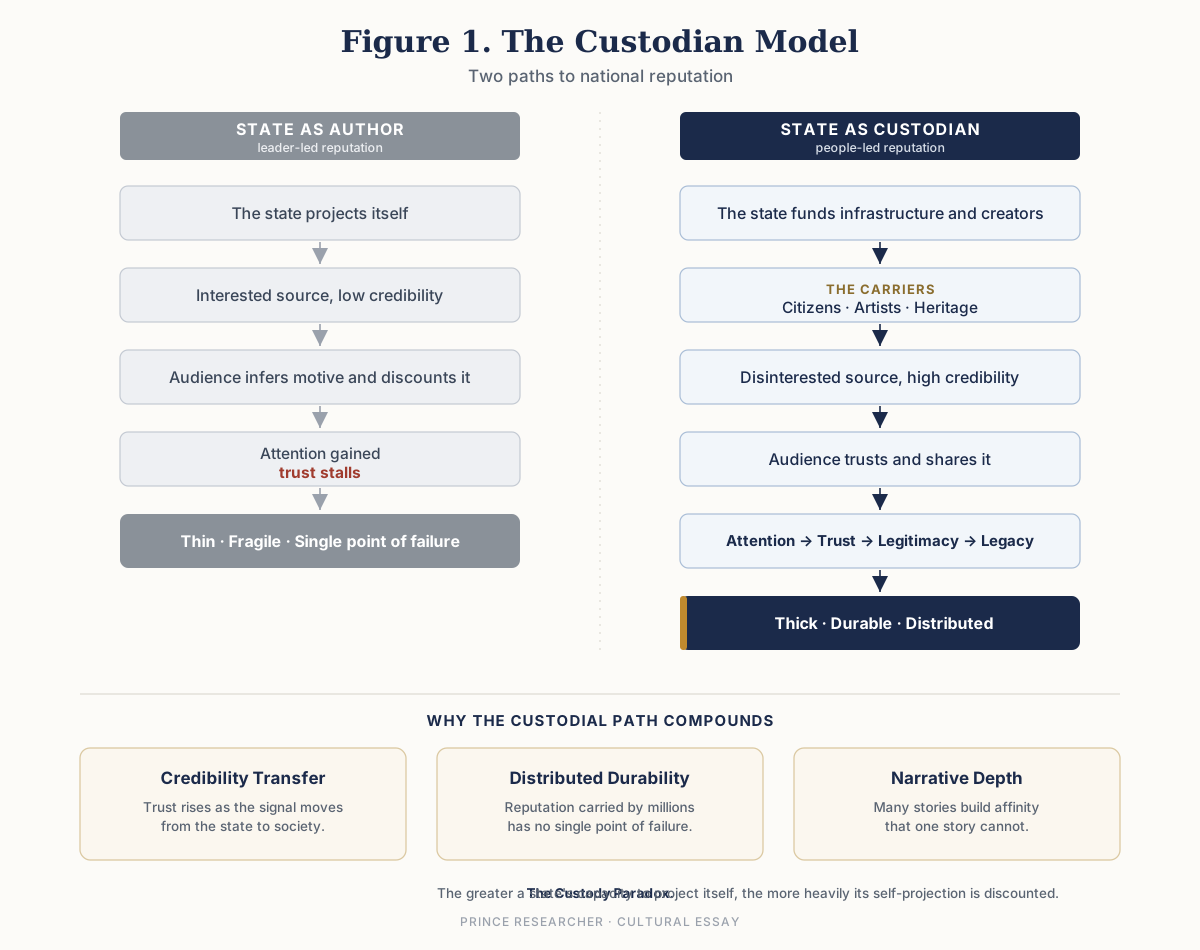
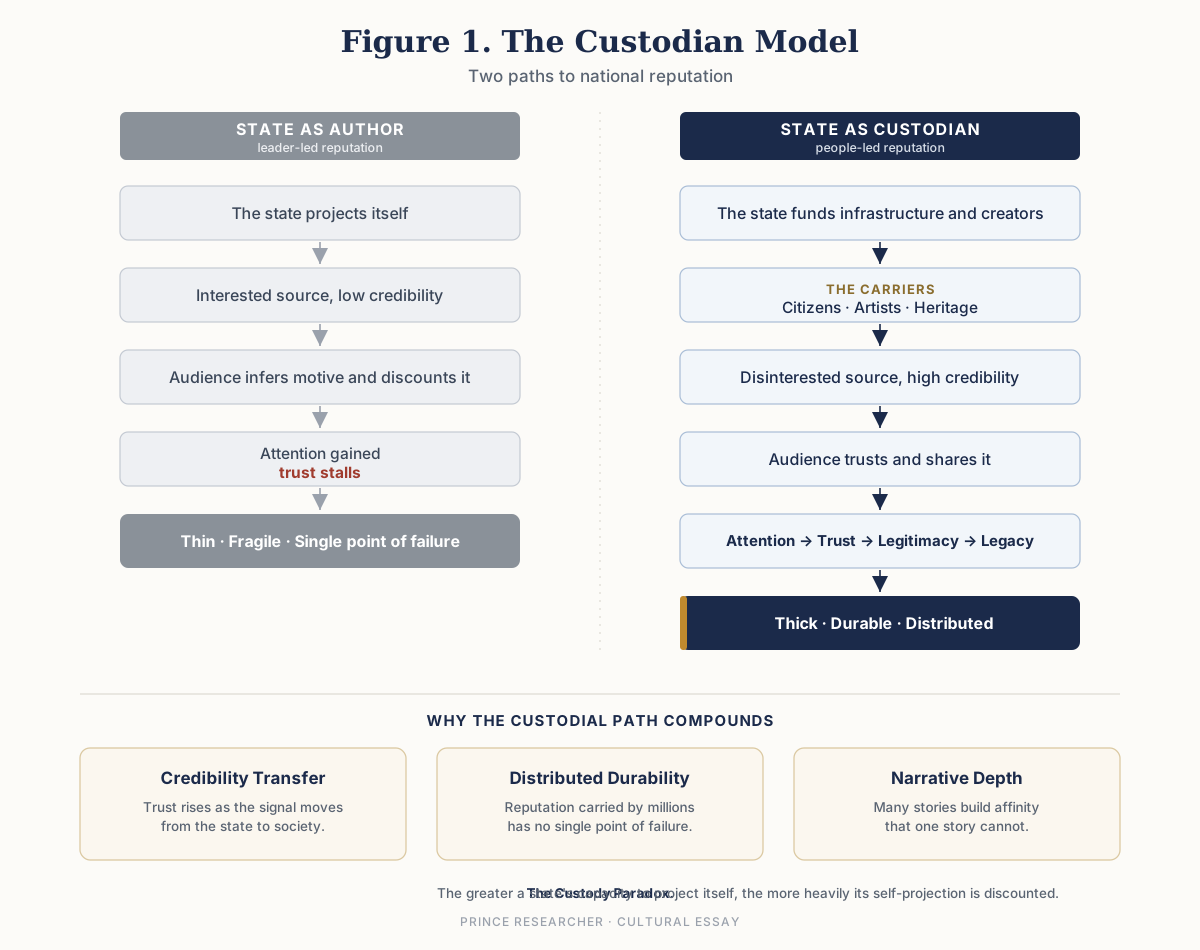
The Custodian Model proposes that durable national reputation is authored by the people and stewarded by the state. In this model, the state’s most effective role is to build the conditions for citizens, culture, and heritage to project the nation, rather than to project itself. Korea is consistent with the model. Japan illustrates the cost of departing from it. Saudi Arabia holds unusually rich material with which to apply it.
Three mechanisms help explain why a citizen-borne reputation may outperform a leader-centred one. Each is stated here as a testable proposition rather than a settled finding.
Credibility Transfer. A claim about a nation appears to gain weight as it moves away from the state. Officials are interested senders, and audiences tend to discount them. Citizens, artists, and voluntary global audiences are disinterested senders, and their signals are costly to fake. Shifting the source from state to society should raise perceived credibility. This proposition is measurable. A controlled survey can hold a claim constant while varying its source across a government account, a citizen creator, and a foreign visitor, then compare perceived credibility.
Distributed Durability. A reputation carried by one leader has a single point of failure. A reputation carried by many cultural touchpoints holds redundancy and should survive transition, controversy, and time. Korea’s stability during its governance crisis is consistent with this claim. The proposition is measurable through reputation resilience, by tracking a nation’s index scores across leadership changes and political shocks.
Narrative Depth. A leader-centred story is thin, and thin stories fatigue quickly. A society-authored story is layered across regions, generations, and forms, and that breadth should build affinity and repeat engagement. The proposition is measurable through the diversity of a nation’s internationally recognized cultural outputs, counted across genres, regions, and years.
These mechanisms map onto a transformation many nations seek. Attention becomes trust, trust becomes legitimacy, and legitimacy becomes legacy. Leader-branding can secure attention and stall there, since the next stage requires credibility the state cannot readily supply about itself. A citizen-borne approach can move further along the chain, because each stage is powered by disinterested carriers.
The government’s enduring role
The model reshapes the government’s role rather than removing it. States remain essential to soft power in ways no other actor can match. They conduct diplomacy and represent the nation in formal settings. They manage crisis communication when events demand a single authoritative voice. They coordinate institutions, set cultural policy, and supply the regulatory and legal scaffolding that creative sectors need. Above all, they can finance cultural production at a scale private markets rarely reach. The Custodian Model asks the state to exercise this capacity as an enabler of citizen storytelling, not as a substitute for it. The argument is about posture, not withdrawal.
The Custody Paradox
One tension shapes how this plays out in high-capacity states. The Custody Paradox holds that the nations with the greatest capacity to project a narrative are often the nations whose self-projection is discounted most heavily. Strong states can fund, build, and broadcast at scale. Aimed at self-promotion, that same strength can produce louder signals that audiences trust less. The resolution the model suggests is to convert capacity into custodial infrastructure, financing cultural production without directing its content.
Conditions and future testing
The Custodian Model appears to work best when a state meets four conditions. It invests in creator capacity and cultural infrastructure rather than in messaging. It funds without authoring, so the state carries the cost, and the people keep the voice. It maintains visible distance between the state and the story, to protect the credibility of the signal. It treats heritage and citizens as the primary carriers, since they hold cultural capital no campaign can manufacture.
The framework rests on three strong cases, which are a starting point rather than proof. Future research should test whether it also explains the soft power trajectories of other nations with long-established cultural influence, from France and Italy to smaller states that punch above their weight. A model that holds across such cases would move from a plausible account to a general one.
Conclusion
The dominant instinct in nation branding is to cast the state as the protagonist of its own story. The evidence assembled here points elsewhere. Appeal tends to be earned by a nation’s people and merely kept by its state.
South Korea rose in part because its government built the infrastructure and left its artists to create. Japan’s experience suggests the difficulty of authoring and monetizing a culture that a nation’s people had already made. Saudi Arabia begins from a position few countries share, holding a citizen-borne signal fourteen centuries deep alongside a funding model that finances creators without dictating their work.
The contribution of this essay is to reframe the problem. Nation branding is often treated as a communications question about who controls the message. The Custodian Model recasts it as a governance question about who carries credibility. Framed this way, the central choices concern how a state allocates cultural investment, how much distance it keeps between itself and the story, and whom it trusts to speak. As a concluding observation, the pattern across these cases is simple. A state does well to build the road and let others write the songs, to fund the culture without narrating the nation.
This is not a smaller ambition than state-led branding. It is a more demanding one. A reputation carried by millions is harder to build and far harder to break than a reputation announced from a podium.
A message can be controlled, yet credibility can only be conferred by others. That is why the reputation a state announces can be revised at will, while the reputation its people carry becomes memory, and memory outlasts every government that inherits it.
References and Further Reading
Academic
- Nye, Joseph S. Soft Power: The Means to Success in World Politics. New York: PublicAffairs, 2004.
- Spence, Michael. “Job Market Signalling.” Quarterly Journal of Economics 87, no. 3 (1973): 355–374.
- Kelley, Harold H. "Attribution Theory in Social Psychology." Nebraska Symposium on Motivation 15 (1967): 192–238.
- Friestad, Marian, and Peter Wright. "The Persuasion Knowledge Model: How People Cope with Persuasion Attempts." Journal of Consumer Research 21, no. 1 (1994): 1–31.
- Brehm, Jack W. A Theory of Psychological Reactance. New York: Academic Press, 1966.
- Anholt, Simon. Competitive Identity: The New Brand Management for Nations, Cities and Regions. London: Palgrave Macmillan, 2007.
- Anholt, Simon. Places: Identity, Image and Reputation. London: Palgrave Macmillan, 2010.
- Bourdieu, Pierre. "The Forms of Capital." In Handbook of Theory and Research for the Sociology of Education, edited by J. Richardson, 241–258. New York: Greenwood, 1986.
Institutional
- Brand Finance. Global Soft Power Index 2025 and 2026. London: Brand Finance.
- Korea Creative Content Agency (KOCCA). Content Industry Statistics, 2023.
- Korea Tourism Organization (KTO). International Visitor Survey, 2024.
- General Authority for Statistics, Kingdom of Saudi Arabia. Hajj Statistics Publication 2024.
- Saudi Vision 2030. Tourism and Culture Sector Reports, 2024.
- Cultural Development Fund, Kingdom of Saudi Arabia. Sector Financing Disclosures, 2021–2025.
- UNESCO World Heritage Centre. World Heritage List: Saudi Arabia.
Journalism and Industry
- The Japan Times. Commentary on Cool Japan and soft power, 2026.
- Kyodo News and The Asahi Shimbun. Reporting on Cool Japan Fund performance and government review, 2022–2025.
- Variety, Screen, and The Hollywood Reporter. Coverage of the Red Sea International Film Festival and Saudi cultural financing, 2025.
- Arab News. Analysis of Saudi Arabia’s soft power and reputation, 2025.
- ORF Middle East. The Rise of Soft Power in the Gulf: A Comparative Analysis of GCC Strategies, 2025.
© Cultural Essay — Prince Researcher | For Academic and Editorial Use