
The Reputation Ledger
Reputation transfers continuously between institutions and individuals, and disclosure is where the balance becomes visible

Reputation transfers continuously between institutions and individuals, and disclosure is where the balance becomes visible
Strategic Essay | Prince Researcher
Abstract
Reputation is usually assigned to a department. Corporate communications owns it, leadership guards it. This essay argues that the assignment is wrong. Reputation transfers continuously between institutions and individuals, and each party carries the other as an asset or a liability. The essay introduces The Reputation Ledger to model this transfer as a shared balance sheet. Its central posting is Inherited Credibility, a stock of reputation employees borrow from the institution before they have earned it themselves. In return, each person posts conduct to the institution as a fast flow, aggregated across every point of contact. No single office holds the balance. Every employee holds a share of it. The essay then introduces The Disclosure Signal. Whether a person names or hides an employer is a costly and revealed measure of institutional standing. Naming signals belief. Hiding signals its absence. Disclosure runs in both directions, and it should be read as a probability rather than proof. The argument draws on signalling theory, impression management, and research on stigma transfer. Reputation is not owned. It is held in common, and disclosure is one of its most revealing audits.
Introduction
The idea surfaced inside a customer experience project at a large Saudi bank. While designing a workshop, one question kept returning. How does the way an employee presents themselves affect the standing of the institution they represent, and how does that standing return to the employee? A professional who presents well raises the perceived value of the entity behind them. An institution with strong standing lends its people credibility they did not have to earn alone.
After the session, a pattern showed in the room. Many participants held their own reputation and their employer's reputation as separate accounts, managed by different people and exposed to different risks. That assumption is common, and it is wrong. Reputation moves across the boundary between person and institution constantly. At firms with weak standing, some employees stop naming the employer and speak of it more negatively, and without intending to, they help set the reputation they are describing. A strong institution does the reverse. It deposits standing into everyone who carries its name.
This essay makes that motion precise. It replaces the image of a two-way circle with a harder claim. The two directions are not symmetric. One is a slow stock, and the other is a fast flow. Existing reputation research explains well how organizations accumulate standing. It says far less about how that standing transfers between institutions and individuals once affiliation begins. This essay models that transfer as The Reputation Ledger, and it identifies a single observable that measures the balance more honestly than most surveys.
Theoretical Framework
Three lenses explain why individual and institutional reputation cannot be separated. A fourth locates the argument in the Gulf.
Signaling and the cost of disclosure
Michael Spence modeled how one party conveys quality to another under information asymmetry. A signal works only when it carries a cost that a weaker type would not pay. Applied to affiliation, the logic is exact. When a professional names an employer in a resume, a talk, or an introduction, they attach the institution's reputation to their own. That attachment carries risk. Because the disclosure is costly and voluntary, it carries information. The reverse carries information too. When a capable person removes an employer from public view, the omission is not neutral. It is a signal that the affiliation may cost more than it returns.
Impression management and the worn institution
Erving Goffman described social life as a performance managed across a front stage and a back stage. The individual presents a curated self to an audience. The employer is part of that presentation. A person does not only present themselves. They present the institution they wear. Every client interaction and every public post is a performance in which the institution appears through the person. The resume is a front-stage document. What a person places on it, and what they leave off, is impression management applied to the affiliation itself.
Stigma transfer and symbolic capital
Corporate reputation research treats standing as a stakeholder asset that can be built and lost. Charles Fombrun framed reputation as accumulated perception with real economic value. Timothy Coombs showed through Situational Crisis Communication Theory that a crisis reallocates blame and standing among the parties attached to it. Sociological work on stigma extends the point downward. Stigma transfers across levels. When an organization is discredited, the discredit spills onto the individuals associated with it, regardless of their personal conduct. A 2022 review by Milo Wang at Arizona State University traced how stigmatization passes from the organizational level to the individual level. Pierre Bourdieu's concept of symbolic capital completes the frame. Affiliation is a form of capital. It converts into deference, access, and the benefit of the doubt. It can also convert into suspicion when the source is compromised.
Relational trust in the Gulf
In Gulf markets, affiliation is more personal than in arm's length economies. Research on wasta by Kate Hutchings and David Weir describes trust that runs through personal relationships and network position rather than through formal credentials alone. In a relational economy, the person and the institution are harder to separate in the eyes of the market. A professional does not represent an institution at a distance. They embody it inside a web of personal ties. This raises the stakes of the reciprocal exposure that the rest of this essay describes.
Case Studies
Case one: the Saudi bank and the sector behind it
What existed before. Employees in the workshop held two mental accounts. Their own professional reputation sat in one. The bank's reputation sat in the other. The corporate communications function was assumed to manage the second account on everyone's behalf.
What changed. The workshop reframed the two accounts as one. It asked participants to see each client interaction as a posting to the institution's standing, and to see the institution's standing as a posting to their own.
What happened afterward. Participants recognized a role they had not claimed. They were custodians of institutional reputation whether or not the title appeared in their job description. The sector made the point concrete. Al Rajhi Bank holds the strongest banking brand in the Middle East, and Saudi banking brands have been among the region's fastest rising in value under Vision 2030. An employee at an institution of this standing inherits credibility before they say a word. These figures do not prove the theory. They establish the precondition the theory needs. The institution already holds the credibility that its people borrow.
What this reveals. Institutional standing is not held centrally. A strong institution grants credibility to the balance of every person who carries its name, before that person has done anything to earn it.
Case two: institutional credential transfer
What existed before. A professional builds a record through their own work. That record is assumed to be personal property.
What changed. Elite firms decided to treat the affiliation itself as a transferable asset. McKinsey tells candidates they will leave with a credential, and that the experience will open more doors than any other institution on their resume. Guides on resume screening report that names such as Goldman Sachs, Google, and McKinsey act as a fast signal in the first seconds of a review, because the name implies that another rigorous selection already vetted the candidate.
What happened afterward. The affiliation became portable and persistent. People keep naming these employers long after they leave. The labels former McKinsey, ex-Google, and Aramco alumnus continue to produce credibility years later. This is the positive form of disclosure. The individual chooses to keep the affiliation visible because it still pays. The alumni network converts into referrals, access, and the presumption of quality. The individual draws on a stock the institution built and continues to guarantee.
What this reveals. The institution grants Inherited Credibility to the individual, and disclosure runs in both directions. Just as hiding an employer can signal lost standing, continuing to name a former employer signals standing that endures. Positive disclosure is the mirror image of the omission studied in the cases that follow.
Case three: Theranos and the disclosure that reversed
What existed before. Theranos was, at its peak, one of the most celebrated startups in Silicon Valley, valued at roughly nine billion dollars with around 800 employees. Association with it was an asset. People named it.
What changed. The company's claims collapsed under investigation. The affiliation inverted from asset to liability in a short window.
What happened afterward. The disclosure signal reversed in the open. Reporting drawn from John Carreyrou's account describes employees being told to list a generic label such as a private biotechnology company rather than Theranos on their professional profiles. An analysis of LinkedIn found roughly 800 accounts that listed Theranos as a past company, with some removing the name entirely. One former employee recalled a recruiter placing a thumb over the company name on his resume while calling him the most qualified candidate. The name had become the one thing the market could not see past.
What this reveals. This is The Disclosure Signal in one of its clearest forms. When capable people hide an affiliation they once advertised, the hiding becomes an audit. It can measure the collapse of institutional standing more directly than a brand tracker, because it is costly and revealed rather than stated.
Case four: Enron and the ledger in reverse
What existed before. Enron employed thousands across skilled functions. Their conduct varied. Most had no part in the fraud.
What happened. The company failed, and the failure did not stay at the institutional level. Nine months after the bankruptcy pushed more than four thousand employees into the job market, an estimated thirty percent were still unemployed. A former logistics manager told the Houston Chronicle that people with Enron on the resume were painted with the same brush. Research by Milo Wang later mapped the mechanism by which such stigma transfers from the organization onto the individual. The pattern persisted for years. Elizabeth Holmes's own father, once an Enron executive, later omitted the company from his public profile.
What this reveals. The flow runs both ways, and it can run against the individual. When an institution loses standing, it posts a liability to the balance of every person attached to it, independent of their own conduct. The individual does not choose this posting. They can only manage the disclosure.
Synthesis Framework: The Reputation Ledger
The cases describe one system. Call it The Reputation Ledger. Reputation transfers between individual and institution as postings on a shared balance sheet, and each party carries the other. Three features define how the ledger behaves.
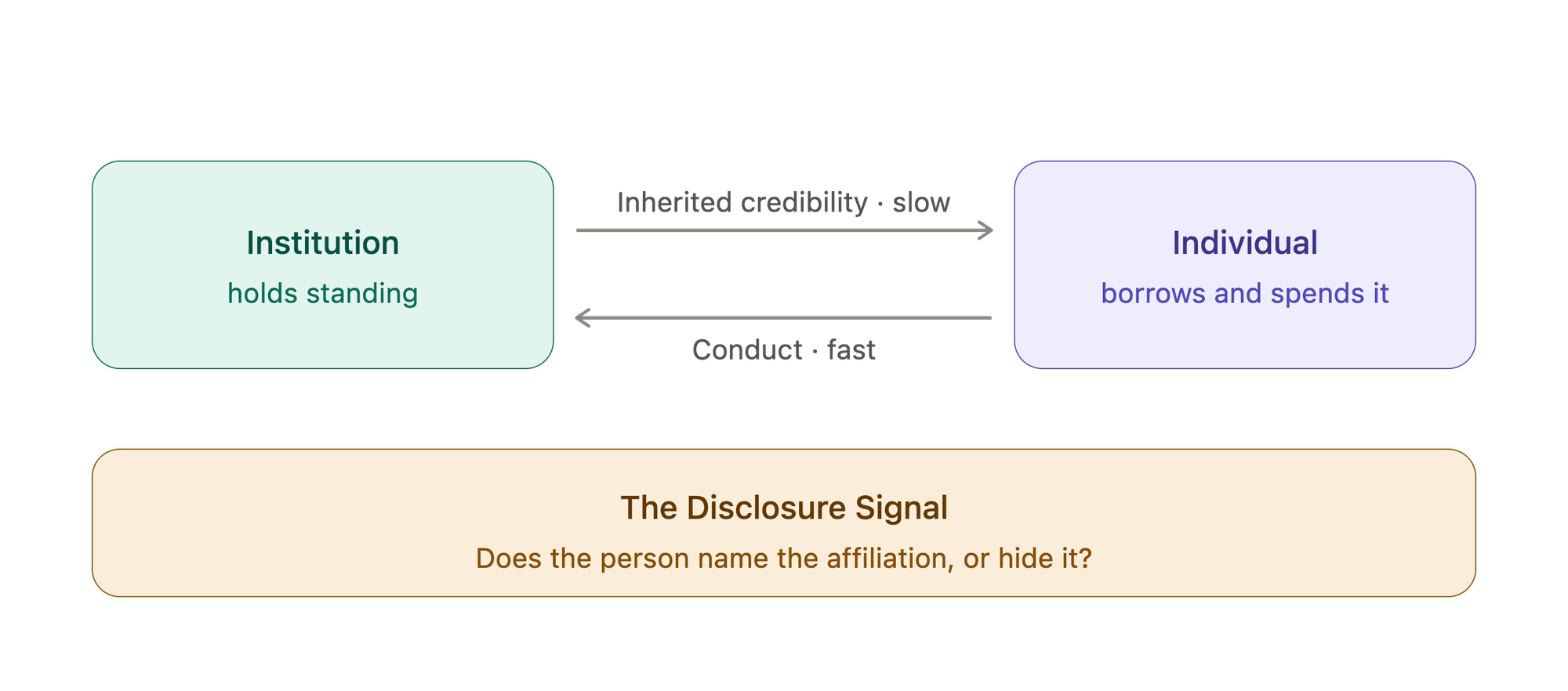
It runs in two currencies at two speeds. The institution grants what this essay calls Inherited Credibility, a stock of reputation employees borrow before they have earned it themselves. The individual posts back in conduct, the impression left at every point of contact. The stock moves slowly, building and depreciating over years. The flow moves instantly, settling at every interaction and aggregating across the whole workforce. Institutions manage the slow currency through the communications function. They tend to under-manage the fast one, because it is distributed across people rather than held in a department.
Its custody is distributed. No office holds the ledger alone. Every employee holds a share of the institution's balance, and the institution holds a share of every employee's. Reputation is therefore not the property of any single office. Its custody is shared across everyone who carries the name.
Its audit is disclosure. The most revealing reading of the ledger is not a survey but observed behaviour. The Disclosure Signal is whether a person names or hides an affiliation. Naming is a costly signal of belief in its value. Hiding is a costly signal that the affiliation costs more than it returns. The signal is symmetric. Persistent naming of a former employer indicates enduring standing, and quiet removal indicates its loss.
Disclosure should be read as a probability, not proof. People remove an employer for reasons unrelated to reputation. Confidentiality, stealth-stage startups, national security work, contract roles, career pivots, and mergers all produce omissions. A single hidden affiliation proves nothing. The signal gains its force in the aggregate. When capable people who once advertised an affiliation begin to remove it in numbers, and when few outside the firm still name it, the pattern becomes one of the strongest observable indicators of where institutional standing has moved.
The framework reframes a practical problem. Institutions that manage reputation through the slow currency alone are managing the smaller account. The larger account is the flow, and people disclose it. The Edelman Trust Barometer has found for years that a person's own employer ranks among the most trusted institutions in their life, and that ordinary employees are seen as more believable sources about a company than its chief executive. The load-bearing channel of institutional reputation is the workforce, not the newsroom. One caution on evidence. The often quoted multipliers for employee shared content, such as several times the reach or engagement of official channels, come largely from vendor studies. They point in a consistent direction and should be treated as directional rather than precise.
Conclusion
The instinct to file reputation under one department is understandable. It is also costly. It concentrates attention on the account that moves slowly and neglects the account that moves fast. The fast account is written by everyone who carries the name.
The relationship between individual and institutional standing is not a one-way transfer, and it is not a symmetric circle. It is a ledger with a slow stock and a fast flow. The institution lends the person credibility. The person writes the institution's standing through daily conduct. Each entry can turn positive or negative, and each party is exposed to the other.
For a strong institution, this exposure is an asset to protect. The credibility it lends its people returns when those people name it and carry it with care, sometimes for the rest of their careers. For a weak institution, the same mechanism turns against it. Its people quietly withdraw the affiliation, and the withdrawal becomes part of the evidence.
The measurement follows from the model. Alongside what people say in a survey, watch what they choose to disclose. The resume can be more revealing than the questionnaire, and the unguarded sentence more revealing than the focus group, because disclosure costs the person something to give.
Institutions do not own reputation. They lend it, borrow it, and share it with everyone who carries their name. The ledger is written every day, and disclosure is where its balance becomes visible.
Future Research
The Reputation Ledger is a conceptual model, and its central observable can be tested. The Disclosure Signal invites empirical study across several directions.
- Employer removal after crises. Track how quickly employees remove a firm from public profiles following a scandal or collapse, and whether removal rates precede later declines in brand value.
- Disclosure rates over time. Measure the share of a firm's current and former staff who name it publicly, and how that share moves with reputation.
- Alumni affiliation persistence. Compare how long former employees continue to name different employers, as a measure of enduring inherited credibility.
- Willingness to mention the employer. Survey employees on whether they name their employer in professional and social settings, and match this against independent reputation measures.
- Resume omission following misconduct. Study omission patterns after organizational scandals to separate reputation-driven removal from unrelated causes.
These studies would convert the framework from a conceptual argument into a measured instrument. In the Gulf, where affiliation is embedded in personal networks, disclosure behaviour may carry more information than in arm's length markets. That regional gap is, at present, largely unstudied.
References and Further Reading
Academic
- Bourdieu, P. (1986). The Forms of Capital. In Handbook of Theory and Research for the Sociology of Education.
- Coombs, W. T. (2007). Protecting Organization Reputations During a Crisis: The Development and Application of Situational Crisis Communication Theory. Corporate Reputation Review.
- Fombrun, C. J. (1996). Reputation: Realizing Value from the Corporate Image. Harvard Business School Press.
- Goffman, E. (1959). The Presentation of Self in Everyday Life. Anchor Books.
- Hutchings, K., and Weir, D. (2006). Understanding networking in China and the Arab world: Lessons for international managers. Journal of European Industrial Training.
- Pozner, J. E. (2008). Stigma and Settling Up: An Integrated Approach to the Consequences of Organizational Misconduct. Journal of Business Ethics.
- Spence, M. (1973). Job Market Signaling. The Quarterly Journal of Economics.
- Wang, M. (2022). Research on organizational and individual stigma and its transfer across levels. Reviewed in W. P. Carey School of Business news, Arizona State University.
Institutional
- Brand Finance. (2025). Banking 500 2025 and Middle East banking commentary.
- Brand Finance. (2026). Saudi Arabia 100 2026.
- Edelman. (2019, 2022, 2026). Edelman Trust Barometer and workplace special reports.
- Saudi Vision 2030. Financial Sector Development Program materials.
Journalism and industry
- CNN Business. (2019). Reporting on former Theranos employees and hiring stigma.
- Houston Chronicle, cited in W. P. Carey News (2022). Reporting on Enron employee unemployment and resume stigma.
- Quartz. (2019). Analysis of former Theranos employees on LinkedIn.
- Carreyrou, J. (2018). Bad Blood: Secrets and Lies in a Silicon Valley Startup. Knopf.
- Employee advocacy benchmark reports (MSLGroup, DSMN8, Oktopost, Sociabble), treated as directional vendor data.
© Strategic Essay — Prince Researcher | For Academic and Editorial Use